
The distance between a plausible-sounding answer and a precise academic judgment — and why Project Mentor assists relentlessly but decides never.
By Huỳnh Minh Phúc·

A general-purpose chatbot can produce a fluent paragraph about almost any thesis topic in seconds. That fluency is exactly the trap. A thesis is not graded on whether a paragraph sounds reasonable — it is graded on whether the argument is sound, the method is appropriate, the citations are real, and the work is the student's own. Closing the gap between plausible and correct is the job of a human advisor, and it is the principle Project Mentor is built around.
Ask a generic model to "review chapter 3" and it will happily return confident prose: tighten the abstract, add more references, clarify the methodology. None of it is wrong, and almost none of it is the specific, accountable judgment a thesis season needs. A supervisor knows that this student over-claims in the results section, that this department expects a particular citation style, that this methodology will not survive the defence committee.
Project Mentor takes a different route from a generic chatbot. It does not try to conjure that judgment out of thin air — it lets the supervisor encode their own, so the AI works from the criteria the advisor actually uses. The aim is not to replace the advisor's judgment but to give it more time and sharper starting points.
This is where a general-purpose model and Project Mentor part ways. A chatbot reviews a draft against its own generic idea of a "good thesis." Project Mentor can review it against yours.
A lecturer sets their own critique criteria once, in their profile. From then on, when the AI critiques a student's submission it works from those criteria — testing the draft against the specific things this supervisor insists on, and pointing to exactly where it falls short of them, instead of returning the same advice it would give anyone.
That critique runs at three intensities. The lightest reads like an encouraging first conversation; the middle asks the balanced questions of a serious supervisor; and the toughest takes the role of a defence-committee chair, generating the pointed questions — on method, alternatives, and threats to validity — that a real panel would put to the work.
None of this decides anything. It is a sharper, more personal starting point — the Accept, Request change, or Discuss call remains the supervisor's, and theirs alone.
Every AI touchpoint in the platform is positioned before a human decision, never instead of it:
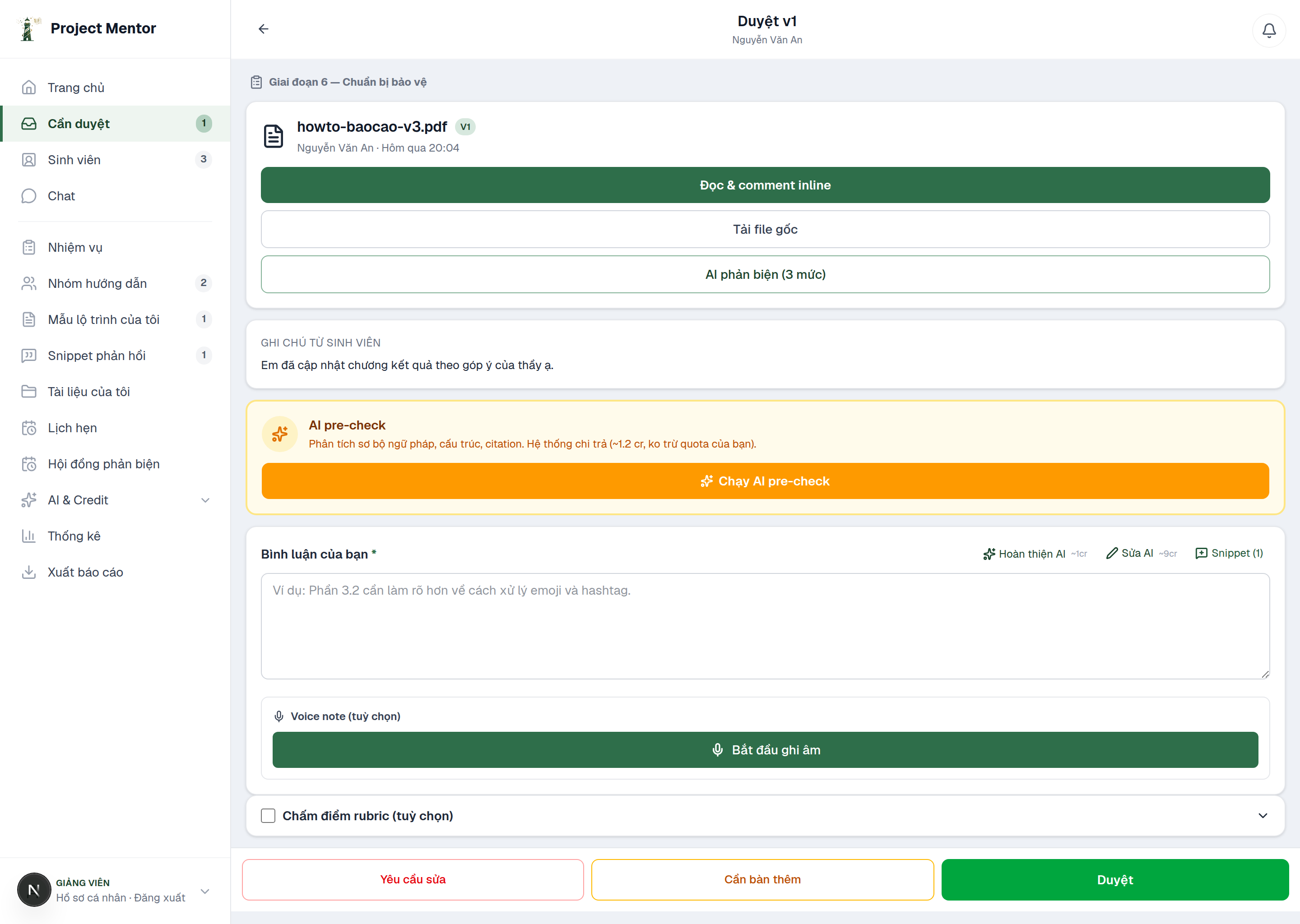
The decision buttons are the point. The AI can draft; only the faculty member can decide.
Universities are accountable for the integrity of the degrees they award. A supervision tool that quietly auto-grades would move that accountability somewhere no one can inspect. So the platform does the opposite: it keeps the human in the loop and keeps a record of what happened.
For a faculty member juggling fifteen students, the win is not "the AI grades for me." It is "I sit down to review and I am already oriented — I know what changed since last version, the AI flagged the obvious gaps, and I spend my time on the academic call only I can make." The advisor stays the advisor. The software just removes the parts that were never the advisor's expertise to begin with.
That is the line Project Mentor will not cross: assist relentlessly, decide never.