
Scoped student AI tools, every interaction logged and attributed, and faculty in control of policy — a defensible stance a university can actually maintain.
By Huỳnh Minh Phúc·
Generative AI is already in every thesis, whether a university acknowledges it or not. Banning it outright is unenforceable and pushes usage into the dark. The more durable approach is the one Project Mentor takes: give students useful, scoped AI tools, make every use transparent, and keep the faculty in charge of policy. Log it, don't ban it.
Inside the platform, a student does not get an open-ended chatbot. They get a small set of task-specific tools tied to their thesis:
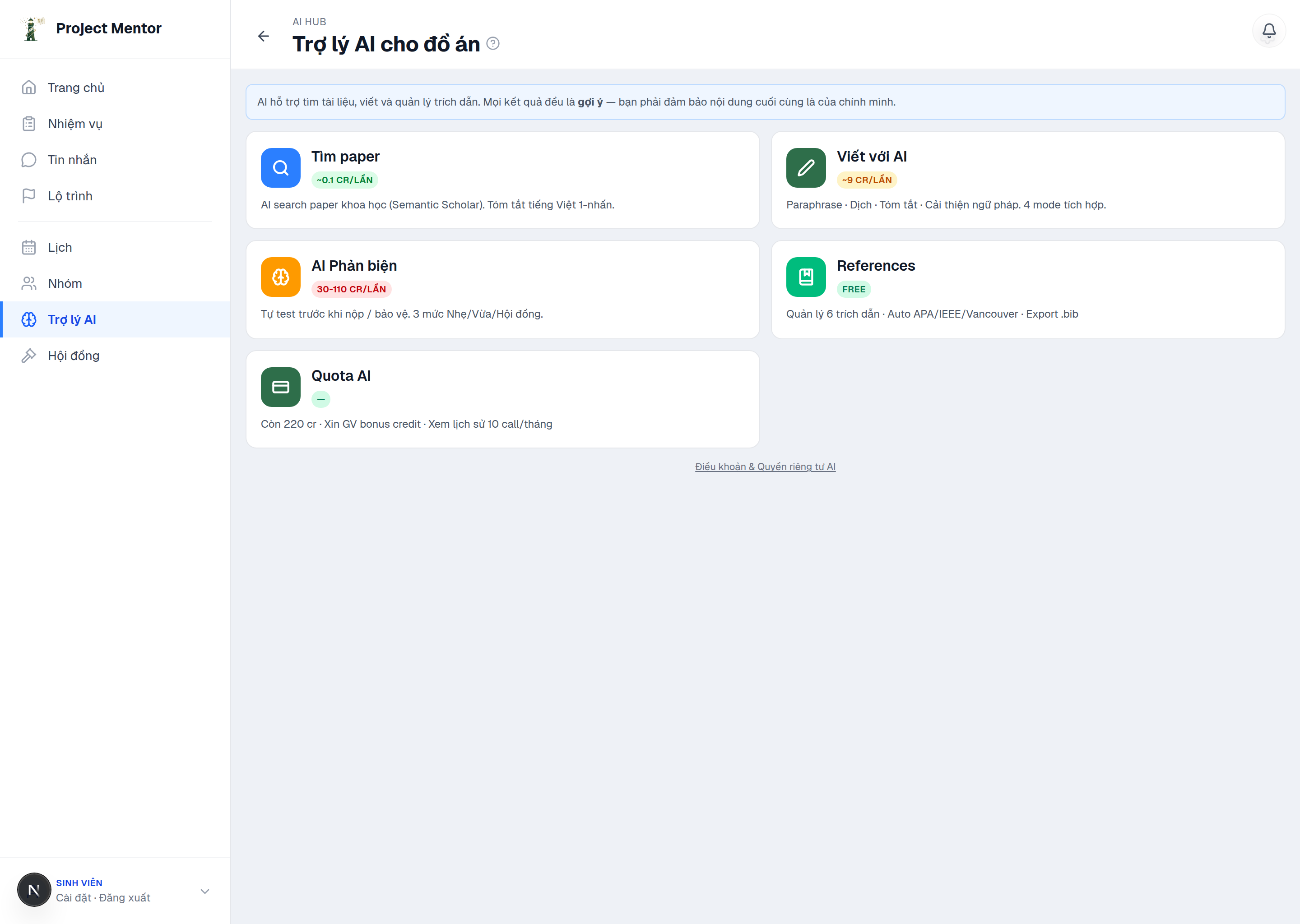
Each tool has a transparent credit cost, so usage is visible and budgeted rather than unlimited and invisible.
The principle is simple: every AI interaction is logged and attributed. A student using the self-critique tool is not hiding anything — the system records it. A lecturer using AI pre-check sees it labelled as such. This makes a healthier conversation possible: not "did you use AI?" (everyone does) but "did you use it appropriately, and is the work still yours?"
Academic integrity, in this model, is supported by visibility, not by an unenforceable rule.
Responsible use is not left to chance. Coordinators can set a faculty-level AI policy, and the platform offers per-feature modes so AI can be turned down or off where a department prefers. Admins manage a three-tier credit budget (system → faculty → user), so AI usage is bounded by real, owned limits. Students can opt out of AI features entirely.
For a faculty trialling the platform, we suggest a light, honest policy:
Generative AI is not going away. A thesis platform that pretends otherwise ages badly. One that makes usage visible and keeps faculty in control gives a university a defensible position it can actually maintain.